Most people never get past the purity number. Somewhere on the certificate there's a big, reassuring 99.6% pure — they see it, feel good, and close the tab. That number is real. But on its own it's the smallest part of the story.
If you've spent any time shopping research peptides, you've seen the letters COA — Certificate of Analysis. It's the lab report a vendor posts to show their product was tested. The difference between a strong COA and a weak one has almost nothing to do with whether the purity says 99.4% or 99.8%. It has to do with who ran the test, what they actually tested for, and whether you can prove the report is real.
At Verifyd, we grade transparency — how much a vendor discloses — not product quality or safety. We don't test products and we don't tell anyone what to put in their body; everything here is research-use-only. But to grade disclosure fairly, we've had to get very good at reading these documents. This is the guide we wish existed when we started.
First: the vendor is not the lab
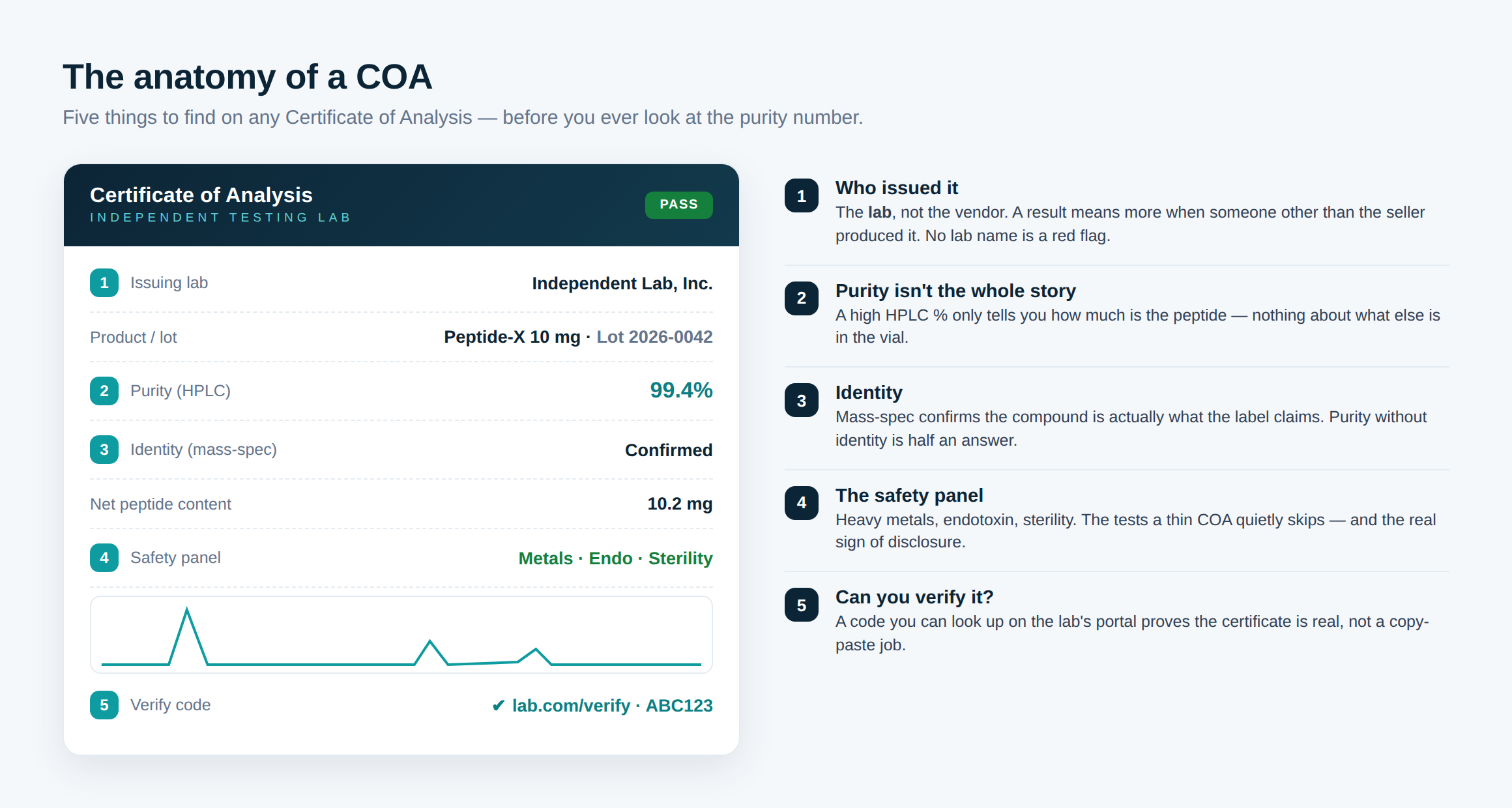
This is the single most important thing to understand, and almost nobody says it out loud. The vendor is the brand selling the product. The lab is the independent facility that tested it and issued the COA. Those are two different companies, and the whole value of a COA comes from that separation — a result means more when someone other than the seller produced it.
So when you look at a certificate, the first question isn't “what's the purity?” It's “who signed this?” Their COAs tend to fall into three tiers — and three labs from our library stand in cleanly for each.
The three tiers of lab you'll run into
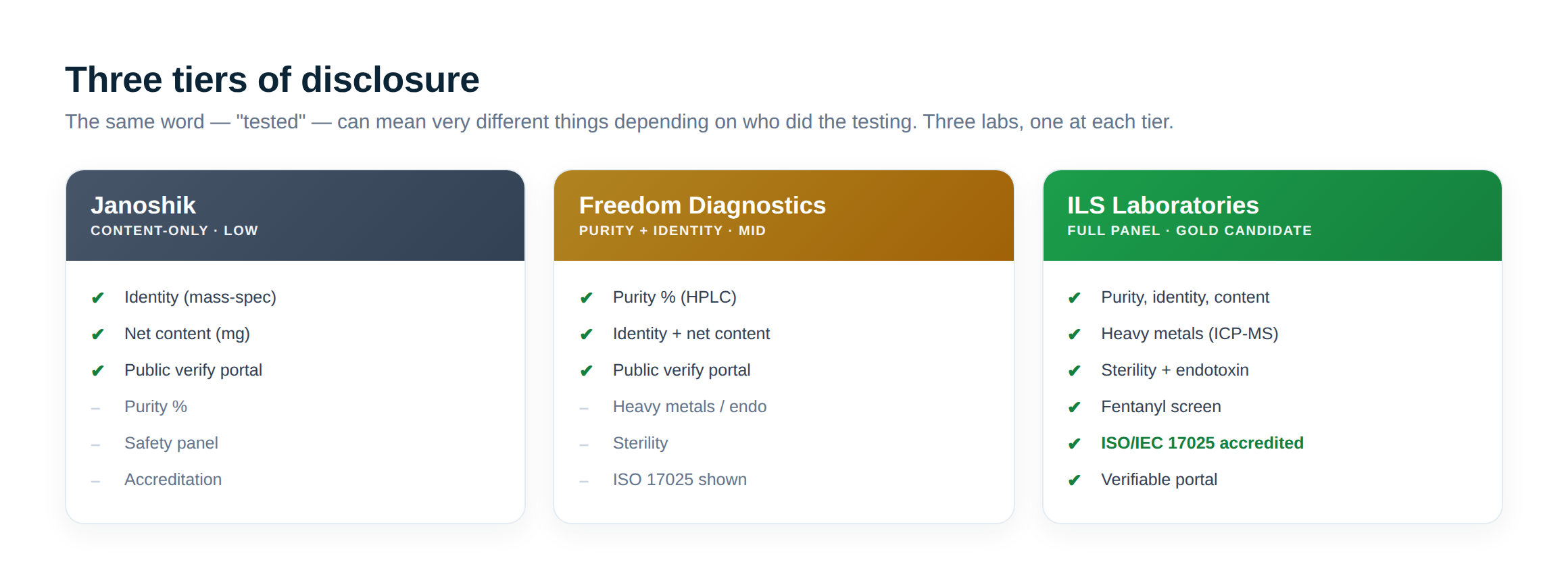
Plenty of labs test peptides — but the certificates they produce tend to cluster into three tiers of disclosure. Here's a representative lab at each level, and why they're not equal.
Janoshik. An independent testing lab that's popular in the research community, partly because regular buyers can send in their own samples. Its big strength is that every report is verifiable — you can look it up on a public portal and confirm it's genuine. The catch is depth: some Janoshik reports show only identity and net content, with no purity percentage and no safety testing at all. A real, checkable result — but a thin one.
Freedom Diagnostics. The most common style of COA you'll see. It gives you a proper HPLC purity percentage (usually 99.5–99.8%), confirms identity by mass spectrometry, reports net peptide content, shows the chromatogram, and offers a searchable verify portal. Genuinely solid, middle-of-the-pack transparency. But it stops at purity and identity — no heavy metals, sterility, or endotoxin — and the report doesn't claim any formal accreditation.
ILS Laboratories. This is what a top-tier COA looks like. Everything Freedom gives you, plus heavy-metals screening, a sterility test, an endotoxin test, a fentanyl screen, a named lab director, an overall PASS, and — the big one — ISO/IEC 17025 accreditation. All of it verifiable. When people talk about a “full panel,” this is the panel.
Here's the part that made us rethink how we score: one vendor in our library used two of these labs. Their flagship product got the full ILS panel. Three of their other products got the purity-only treatment. Same brand, wildly different disclosure — depending entirely on which product you looked at. Which brings us to the two ideas that separate a careful reader from a fooled one.
“Verifiable” and “accredited” are not the same word
Verifiable means you can confirm the certificate is real. The lab gives you a code, you type it into their portal, and the same numbers come back. This protects you from the oldest trick in the book: a vendor editing a PDF or reusing someone else's report. If a COA has no verify link, treat the whole thing as unconfirmed.
Accredited means an outside body has audited the lab and certified it's technically competent to produce that result — the ISO/IEC 17025 standard. A lab can be perfectly verifiable and still not be accredited. Accreditation is a higher bar: it means someone independent has vouched for the lab's process. When you're comparing two vendors, that distinction is often the tiebreaker.
Purity is not the panel
Now back to that big 99.6% that started all this. Purity tells you one thing: of the material in the vial, what percentage is the peptide you ordered. It's useful. But it is silent on everything that isn't the peptide. A powder can be 99.7% pure and still carry heavy metals, bacterial endotoxins, or fail a sterility check — because none of those are what “purity” measures.
The tests that fill in the rest of the picture, in plain terms: heavy metals checks for toxic contaminants like lead and arsenic; endotoxin measures bacterial byproducts that can cause a reaction; sterility is whether anything is growing in the sample; net peptide content is how many actual milligrams of active compound are in the vial (often less than the label); and identity confirms the compound is what it claims to be. The breadth of testing — not the height of the purity number — is the real signal of how much a vendor is willing to show you.
How to read a COA in 60 seconds
Who issued it? Find the lab's name. Vendor ≠ lab. No lab name is a red flag.
Can you verify it? Look for a portal and a code — and actually check one if you can.
Is the lab accredited? Look for ISO/IEC 17025. Not always present, but it's the top tier.
What did they test? Purity and identity are the floor. Heavy metals, endotoxin, and sterility are the sign of a vendor showing their whole hand.
Is it this batch? A COA should name the specific product and lot number, dated. A generic or undated certificate isn't really about the vial in your cart.
Where Verifyd fits
Decoding all of this by hand, vendor by vendor, is exactly the tedious work we built Verifyd to do. We scan a vendor's published COAs and grade how much they disclose — verifiable or not, accredited or not, full panel or purity-only — and publish a plain, consistent transparency score. We don't test products, we don't rank them by quality, and we never tell anyone to use a research compound. We just make the paperwork legible.
Skip the manual read.
Paste any peptide vendor's URL and we'll email you a transparency report — free.
Verifyd Index grades disclosure and transparency, not product safety or quality. All products referenced are research-use-only and not for human consumption. Lab capabilities and accreditations change over time; verify current information directly. This article is educational and not medical, legal, or purchasing advice.